Wednesday, April 7, 2010

Historic Sites in Lebanon

The Temple of Jupiter is located at Baalbeck and is one of the tallest of all the Roman ruins in the world. Six Corinthian columns stand today thrusting 22 meters tall (that is 72 feet). There were 54 columns in the Great temple of the Sun as it is also known.
The great court was located inside the hexagonal court and contained
two altars and other installations of the cult for sacrifices.
It is located at Baalbeck as well with some of the remains found there believed to have been built most likely in the second century. Other remains at the site date back from the 3rd to the 1st century B.C.
The Temple of Bacchus was built in the second half of the second
century A.D. It is larger than Parthenon of Athens and measures 69 meters by 36 meters. It is a striking remnant that has survived numerous earthquakes and still stands in remarkable condition.


Another view of the view of the columns of the Temple of Jupiter.


The city of Anjar was built in the era 650 AD and lasted until about 744 when Anjar was destroyed after having served a s major trade center of the region. It is completely different from any other archeological site in Lebanon. It represents a single period of time, the Umayyad. There were 600 small shops located in the compound as well as two palaces, a mosque, individual houses and Turkish baths. It is located close to the scenic city of Zahle' in the Becca Valley.


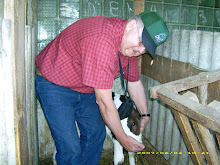
A shepherd is shown with his lead goat that also serves as a watch post for him and helps to prevent strangers or predators from attacking the flocks. When I visited the goat came to rest about two feet behind me and kept a keen eye on me. I turned to see him and noticed what he was doing and told the son of the director that I believed the goat was a king! The boy told the shepherd and then posed with him for this photo.


A shepherd and his son are shown here at lunch time where


they enjoy shepherd's tea and some soft cheese curds and flat bread. The director of ACDI/VOCA office in Beirut is shown with his sons having tea with the shepherd. I was treated to the tea as well as having some roasted truffles that they had found in the mountains and roasted in the fire where the tea was brewed. It was a special treat that I had not known before!


Fat tail sheep are commonly found grazing in the mountains during
most of the year. During spring they move lower in the valley for grazing of barley, wheat and vetch pastures for finishing yearlings.


Raousheh is the name of the rocks found in the Mediterranean Sea just off the coast at Beirut. They are a popular landmark for tourists to observe in the beautiful waters of the Sea.

Monday, August 31, 2009

Some observations of life in Lebanon


My motel room was a small bungalow with air conditioning, refrigerator, table and chairs and twin bed. It was roomy and provided a quiet place to work and rest. During the day temperatures in the fields near the sea were warm and humid. I saw some really good fields of corn and alfalfa. All were receiving some kind of irrigation as no rain falls from mid-April to about mid-September. Outside my room many kinds of fruit trees grew, including fig, pomegranate, plum, cherries and grape vines. A rooster started crowing each morning at 4:30 and other chickens ran loose in the fenced area that contained the motel and restaurant. It was necessary to watch my step as I walked!


I stayed at the Motel El Sayad, near the village of Baino. It was located in the beautiful hills leading to the mountain ranges arising from the sea and was about 30 minutes from the Mediterranean Sea. A restaurant was part of the complex. The food was good. The atmosphere was wonderful with some fantastic views of the mountains and valleys. A cool breeze cooled me off in the evening as I dined under the stars on the terrace!


In the Bekaa valley situated between two mountain ranges that run parallel with the Mediterranean Sea the elevation is over 700 feet above the sea. Air is much drier, the sky is much clearer and there is less haze during the heat of the day. This photo shows a Syrian refugee sitting on a rock herding a herd of 9 dairy cows. In the foreground there are many tents where other refugees live while performing seasonal labor in the valley. Syria is located just over the mountain range seen in this photo.


The village of Baino could be seen nestled in the valley from my motel where I stayed. There were many deciduous trees in the village and in the fall the maples, sweet gums and oaks reveal some brilliant fall color. Baino is about 700 feet above sea level.


Houses in the village of Baino had some interesting architecture. They were built of stone and had a clay tile roof. Most had fenced courtyards with small fruit trees and lots of flowers as well as some vegetables for table use.


Lebanon is known for its cedar trees that have been referred to in the Bible. Some are reported to have lived more than 2000 years. This small cedar tree is growing on a hill near the motel where I stayed. Across the valley one can see the border with Syria.


Olive trees are grown in plantations mostly on the soils at rising elevations from sea level. These soils are fairly rocky and unsuitable for row crop production. It is not unusual for plantations to have 15,000 or more trees. They get no supplemental irrigation, other than rainfall from mid-September to mid-April, and during the hot summers they get only dew from the air. Dew falls early in the night and lasts until morning.


Olives are picked in mid-October. They are squeezed for oil soon after picking to avoid rancidity. I ate olives nearly every day at breakfast and as an appetizer at many other meals.


Grapes hang from trellises at nearly every residence. White grapes seem to be the preference of Lebanese. Most are seedless and very tasty!


This photo shows some of the field workers who helped with silage harvest. The man with the wide brim hat was my host at the Cooperative Livestock Husbandry in the Akkar region of Lebanon.


Chopping corn for silage was done with a six row harvester with silage blown into trucks. Three men rode in the trucks to keep the chopped corn distributed evenly in the truck.


A small boy rides a donkey leading sheep to another spot to graze. Dogs help to keep the sheep out of places where they are not welcome. Another small boy followed behind the more than 200 sheep in this flock.


Sheep and goats are raised thoughout much of Lebanon, especially in areas where few people live. Herding is done with dogs and laborers who spend entire days with the animals.

Friday, August 21, 2009

Forage Production in Lebanon


Corn has been grown in Lebanon only since 2000. The seasons are similar to much of the Midwest in the higher elevations between the two mountain ranges that run parallel to the Sea. Soils are largely a mixture of sandy, loam and clay with a high pH requiring no limestone applications. Most of the corn is harvested for silage and used to feed ruminant animals in Lebanon and to export to neighboring Jordan.


Houses in Zahle' were built high on the mountain ranges with fantastic views of Bekaa Valley. Most were built of stone or concrete. Many were multiple levels and multi-family as well. The sky was clear and the air was light in this region. It was hazy near the Mediterranean Sea because of the high humidity, but in the Valley it was clear.


Corn grown in the no-till plots was being irrigated with drip irrigation methods. Otherwise corn was irrigated by either sprinkler or furrow methods. The drip system is much more efficient than other methods, but is labor intensive.

A no-till planting field day was held at the Agricultural Experiement Station of American University of Beirut where farmers learned about no-till planting equipment and saw fields of corn being grown.


Alalfa was grown for hay. This photo was taken in the Bekaa Valley east of Beirut near the city of Zahle' between the western mountain range and eastern mountain range that borders Syria. The atmosphere had lower humidity and it was cooler in the valley than near the Mediterranean Sea.


The message on a fence near the Mosque at Martyr's Square had the following words, "Leave no stone unturned as you journey through life" in English as well as in Arabic. Not bad advice for an adventurer!


This photo is taken at Martyr's Square in Beirut. It represents the sacrifices of the many who have fought to preserve freedoms in Lebanon. In the background is the Mosque built to commemorate the leaders who have given their lives as they served their country.

Saturday, November 22, 2008

Russian Places


St. Basil's Cathedral is one of the most colorful and most photographed churches in Russia. It is located in the southeast corner of Red Square and was built in the mid-1500's when Ivan the Fourth (Ivan the Terrible) was
Tsar.


Cemeteries in Russia appear to be filled with much ornamentation. Basically the burial plot has a seat with a table for the bereaved to be seated and drink tea and to mourn. Many of the stones have photos etched into them. Both live and artificial flower arrangements adorn the gravesite.


The scaffolding surrounding the church in the photo is there for restoration. The church was likely bombed by communists to prevent citizens from worshipping there during Soviet times. Volunteers come from all over the world to assist with restoring the many damaged churches.


Many of the markets are open air temporary markets. When one wishes to try on a garment the vendor supplies a curtain for you to stand behind.

This artist is with his stand of lacquered boxes. They show excellent detailed art work with various scenes and then are covered with finishes that make them quite beautiful.


This house is where Ivan Turgenev wrote many of his world classic novels describing life in Russian villages during the middle 1800's. It is now a museum along with the estate with virgin timber. I was able to tour it in July, 2008 when I stayed at Chern, south of Moscow.


The twin churches of St. Jacob and St. Dimitri are located on Lake Nero, in Rostov, another of the Golden Ring Cities that attracts many tourists. They were used to store military equipment during Soviet times and are now being restored.


Whenever I leave Moscow to go to a farm assignement I go by train. Sometimes it is an overnight train lasting about 12 hours and more recently it has been about 4 to 5 hours and much closer to Moscow. The trains are not air conditioned and are rather hot in summertime. When I go for the longer trips I have a sleeper car and meals are provided.


Russians love to eat ice cream! This is an ice cream kiosk near the hotel where I stayed. There were three such kiosks at the intersection. All the ice cream cones are pre-filled at the plant and sealed in cellophane. It is tasty!


This photo shows part of the Vologda Kremlin located at Vologda on the Volga River. It was a monastery and was the seat of government in earlier times. It has many museums located there today. Vologda is known for its fine lace production made from flax grown in the region.


This is a scene at the open air flea market in Moscow with three women dressed in native costume. These women sing there everyday the market is open. Artists bring their work there to sell mainly to tourists. The vendors love to haggle on price and it can be entertaining.


When one gets hungry for American food in Russia. No fear! McDonalds is located in all the larger cities. Usually there is a long line. The food is very similar to that found in America and the prices are too, which makes it quite high priced for Russians.


This monument shows the two monks who developed the Cyrillic alphabet for the Russian language. The alphabet has 32 letters with each having its own sound. Many letters look similar to the English letters but may have totally differing sounds. There is no "S" in Cyrillic, but rather the letter "C" has the sound of "S". The letter "P" is sounded as "R". It takes some getting used to, but I can read quite a bit of Russian now.


This is the eastern side of the Kremlin as it is seen from the Moscow River in downtown Moscow. There are many churches located in the Kremlin. Red Square is located within the Kremlin and has two churches on its site. The walls surround it and have many sentry ports where military guard and protect it.


The Volga River starts near Tver, northwest of Moscow, and runs to the Black Sea. Many tour ships provide tours for visitors around the world. During summer there are lots of people touring the Golden Ring Cities which were founded over 1000 years ago. Many monasteries are found in the Golden Ring Cities and were important in bringing christianity to inland Russia as trade developed.


The Tolga Monastery is located near Yaroslavl and sits on the banks of the Volga. It is surrounded by walls with sentry ports for protection to defend against invaders. Most of the gold and valuables were stored in the monasteries in early times. These buildings were used as a prison and tuberculosis sanitarium during Soviet times. They are now being restored by nuns.


This is a scene inside the Tolga Monastery showing a meditation chapel, some of the beatifully kept grounds and churches.


This banner is on the bridge over the Volga River at Yaroslavl and depicts the 1000 year anniversary of its founding in the year 1010. The city is preparing for lots of tourists during the celebration and has much renovation going on. There are many colleges and universities located in Yaroslavl. I have stayed there several times as it is near the center of all the dairy industry. There are many services available for dairymen that are located in Yaroslavl. As word gets out that I have been to a dairy farm and made new recommendations the sales staff carry this information to other farms. When I was there in April, 2008 I trained at least 18 different staff from industry in addition to the farm staff.


The city of Uglich, founded in 937 A.D., sits on the Volga River and is another of the Golden Ring Cities. Several churches are seen in the back ground along the river. This was the site where Dmitri, the young son of Tsar Ivan the Fourth (Ivan the Terrible), was found dead from a dagger. His body was taken by foot to Moscow for burial (about 150 miles) and each time a drop of his blood touched the soil a new church was built. More than 60 churches were built as a result between Uglich and Moscow.


Sunset on the Volga in July was a particularly beautiful sight and caught my eye as we were winding down a long day.


These photos represent sites away from dairy farms where I was able to tour museums, churches, monasteries, markets and monuments.